

Leave No Trace Behind 💧
Your conversations with Claude aren’t a secret anymore.

This week we received another reminder that not every AI story is about who’s winning the AI arms race.
Google DeepMind’s CEO stepped down to focus on research, with a new lineup of executives to take the helm of the company’s AI arm. Anthropic is tagging all content generated with its models with a watermark, an effort that ensures it has ticked the right boxes under the EU AI Act.
Paired together, these two stories show the AI industry’s biggest players are under pressure from very different directions: one from regulators, the other from within.
This week, we look at:
Anthropic’s latest decision to disclose all AI-generated content.
Whether the UK Parliament is right about how UK banks deal with crypto firms.
Why Google DeepMind’s latest hiring and firings could impact the AI race.
[Claude can’t keep a secret 🤫]
Anthropic will now watermark any text constructed with its models.
The Context 🧑💻:
Anthropic will now ensure that any content generated with its Claude models is labelled with a faint watermark on all models released after August 2nd.
This decision aligns with the EU AI Act’s new transparency code, which requires companies to disclose AI-generated content.
The watermark will either be hidden in the immediate text pulled from Claude, or it will be attached as metadata to any file (for example, a JPG file) that has been generated or edited with Claude’s models. The watermark will not tamper with the meaning or readability of Claude’s response.
Anthropic’s decision follows a list of other companies that are transparently disclosing AI-generated content. Last month, Substack announced its reader-triggered AI scanner, which tells readers how much AI-generated content is in the articles they read. YouTube also released its latest amendments to its “inauthentic content” policy.
The Coverage 📰:
“Claude will apply invisible watermarks to AI text and images” (The Verge)
“Anthropic says it will watermark text generated by its AI models” (TechCrunch)
“EU compliance, delivered globally: Anthropic to watermark Claude’s output worldwide” (Euronews)
PR Perspective 🔎:
So, now that Anthropic has done this, are they expecting to become the fairest frontier model of them all? The coverage above indicates that this new feature is Anthropic’s public attempt to flag AI-generated content amid the backlash over ‘AI slop’ that’s upset the online community. The irony is that the company positioning itself as calling out AI slop is the same one building the infrastructure to keep producing endless amounts of AI-generated content. Whether this decision wins over the AI-skeptical or not, it will be interesting to see whether the ‘AI company exposes AI’ narrative persists across other AI firms under the same scrutiny.
[UK Crypto Hits A Banking Wall 🏦]
UK lawmakers are warning that restrictions imposed by banks could hold back the country’s growing crypto industry, even as new regulation approaches.
The Context 🧑💻:
The UK’s crypto and digital assets all-party parliamentary group has written to British banks after “repeated instances” of crypto companies struggling to open and maintain accounts. The group warned that poor access to banking could become one of the industry’s biggest barriers to growth.
Restrictions also extend to consumers. HSBC, NatWest, Monzo and Nationwide impose limits on transfers to crypto exchanges, while Starling and Chase UK block them entirely. Banks say the measures protect customers from fraud, scams and losses due to volatile crypto prices.
The issue is already affecting the industry. The UK Cryptoasset Business Council conducted a survey in January with 10 regulated exchanges, including Coinbase, Kraken and Gemini. It found that 40% of payments to crypto platforms were blocked or delayed, and 70% of respondents said banking restrictions were affecting investment and hiring plans in the UK.
The scrutiny comes ahead of the UK’s new crypto regulatory regime, due to take effect in October 2027. Lawmakers argue that banking access will need to improve alongside regulation if the UK wants to attract and retain digital asset businesses.
The Coverage 📰:
“Banks’ refusal to take on crypto firms risks stunting UK industry’s growth, lawmakers say” (The Financial Times)
“’One of the single biggest barriers to growth’: UK lawmakers press banks over crypto access ahead of new FCA regime” (The Block)
“UK Lawmakers Accuse Banks of Hindering Crypto Sector’s Growth” (PYMNTS)
“UK Banks Block 40% of Crypto Exchange Payments, Industry Survey Finds” (Yellow News)
PR Perspective 🔎:
The UK can build clearer crypto rules, but their impact will be limited if regulated companies still struggle to access basic banking services. From a media perspective, this reflects a wider question around whether traditional financial infrastructure is keeping pace with regulation. Banks are likely to face growing pressure to explain how they distinguish legitimate, regulated crypto businesses from the risks their restrictions are designed to address.
[Who’s Actually Steering DeepMind?🧠]
DeepMind’s new chief has one job: ship faster.
The Context 🧑💻:
Google announced its biggest AI leadership shakeup yet. Demis Hassabis steps down as DeepMind CEO to become chairman, focusing on research and AGI. Koray Kavukcuoglu (previously CTO) takes over as SVP, reporting directly to Sundar Pichai.
Chief scientist Jeff Dean, a 27-year veteran and Google’s 30th employee, is leaving with three other senior researchers (Sanjay Ghemawat, Quoc Le, Oriol Vinyals) to launch Discovery Loop, a startup aiming to automate science and engineering experiments.
The shakeup follows a rough year for DeepMind. Gemini 3.5 Pro has missed three release deadlines, and Google fell behind OpenAI and Anthropic on coding benchmarks after deprioritising the area last year, according to current and former engineers.
Google’s Pentagon deal, permitting “any lawful use” of Gemini on classified networks, has drawn an open letter from 580+ employees and triggered a unionisation drive at DeepMind’s London office, the first at a frontier AI lab. Anthropic, by contrast, kept restrictions on autonomous weapons and mass surveillance.
Several reports frame the reshuffle as a power shift from DeepMind’s London base to Mountain View, pointing to Kavukcuoglu’s California location and recent departures of London-based AlphaFold veterans to Anthropic. Google has disputed this, saying it remains committed to its London presence.
The Coverage 📰:
“Google’s new AI boss inherits a race to catch OpenAI and Anthropic” (CNBC)
“How stalled models, missed deadlines, and staff burnout led to the unraveling of Google’s DeepMind” (Fortune)
“London’s DeepMind Loss Leaves a Very Bitter Taste” (Bloomberg)
“The messy politics behind Google’s big AI shakeup” (The Verge)
PR Perspective 🔎:
The real change here is control. Kavukcuoglu’s appointment was announced the same day Dean left; now he runs DeepMind day-to-day and reports straight to Pichai from Mountain View instead of London. Experts read this as Google trading research depth for shipping speed. Hassabis was focused on building AGI beyond LLMs. Kavukcuoglu’s focus is going to be closing the gap with Anthropic and OpenAI, especially after Gemini 3.5 Pro missed three release deadlines. Dean’s exit, alongside the AlphaFold researchers who left for Anthropic, is part of a broader wave of people leaving who built DeepMind’s reputation.
[Tweet of The Week]
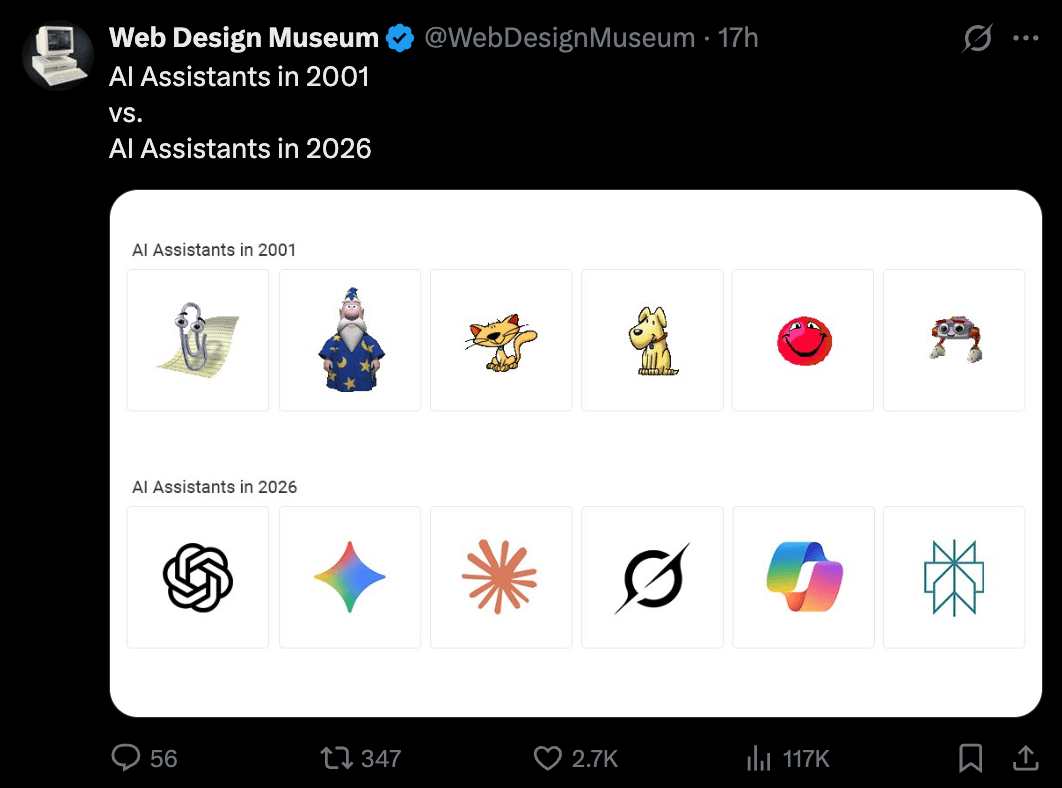
Credit: @WebDesignMuseum
Connect with YAP Global: Website, X & LinkedIn
The usual disclaimer: This newsletter collates the main themes and headlines of the week in DeFi/digital assets/Fintech/AI land and tries to provide unbiased context. It’s aimed at anyone who wants to keep an eye on the space. It’s put together by a team at YAP and doesn’t contain any promotion of our clients (if one is mentioned, we’ll flag that).
The team: Founder Samantha Yap, Samvidha Sharma, Alex Revutsky, Sofia Anderson, Wenwei See, Meghna Dembla, Shajar Qureshi, and TJ Thomas. Your feedback is, as always, welcome. Ping us at thecontext@yapglobal.com. Old newsletters can be found here.
This newsletter is prepared by YAP Global, a financial and technology PR consultancy that advises companies in the digital assets, fintech, stablecoins, AI, and agentic finance sectors. Find out more about us here.