

Saylor sets sail ⛵
But this time, where is he going?

Strategy CEO Michael Saylor made his biggest Bitcoin sale since 2022 and people have lost their minds, all because he defied his longtime rule of “never sell.” Meanwhile, someone has physically unlocked their, yes, physical Bitcoin – valued for a pretty $1.78 million. You could say that these two stories are two sides of the same coin.
This week, we’ll look at:
Strategy’s latest Bitcoin sell-out
A 15-year-old physical Bitcoin with a $1.78 million price tag
Microsoft’s big jump into the AI race

[Saylor’s New Strategy? ₿]
Michael Saylor broke his own golden rule, and even a $2.5 million sale was enough to rattle a market already on edge.
The Context 🧑💻:
Strategy sold 32 bitcoin for $2.5 million between May 26–31, its first bitcoin sale since December 2022, at an average price of $77,135 per coin, using proceeds to fund preferred stock dividend distributions.
The sale, though financially negligible against Strategy’s $60+ billion bitcoin position, shattered the psychological foundation of Saylor’s years-long “never sell” narrative, triggering a 6% drop in Strategy shares and pushing bitcoin below $72,000 for the first time since April.
The move is part of a broader strategic pivot announced in May, where Strategy signalled it would actively manage its bitcoin balance sheet, including selective sales, to improve bitcoin-per-share metrics and fund yield-bearing preferred stock products like STRC, rather than purely accumulating.
The sale landed during an already fragile moment for crypto: bitcoin ETFs posted a record consecutive outflow streak of 10+ sessions totalling nearly $4 billion, AI stocks continue drawing capital away from digital assets, and geopolitical risk from U.S.-Iran tensions is fueling broader risk-off sentiment.
The Coverage 📰:
“Strategy shares fall after selling $2.5 million in bitcoin, its first sale since 2022” (CNBC)
“Saylor’s Strategy Sells Bitcoin for First Time Since 2022” (Wall Street Journal)
“Bitcoin faces mounting pressure beyond Strategy sale” (Axios)
“Bitcoin slides toward $70,000 as Strategy’s BTC sale, geopolitical risks weigh on crypto” (The Block)
PR Perspective 🔎:
This story is a masterclass in how narrative can outweigh numbers. Thirty-two bitcoin sent markets tumbling and sparked a week of negative headlines. For the industry, it’s a reminder that bitcoin’s price psychology is still heavily anchored to a handful of large corporate holders and the stories they tell. Saylor built a demand narrative so powerful that even the smallest deviation from it became a market event. For firms operating in the digital asset treasury space, the lesson is that the credibility of your commitment is a financial asset in itself, and once the market starts questioning it, the damage can far exceed the dollar value of any single transaction.
[Microsoft Goes (AI)n-House🏠]
With new MAI models and Copilot integrations, Microsoft is making the case that the best AI is the one already built into its products.
The Context 🧑💻:
Microsoft is moving from being an OpenAI partner to a direct AI competitor. It is launching its own MAI models across coding, reasoning, voice, and image tasks, signalling a push to build more of its AI stack in-house.
The main drivers are control and cost. By running proprietary models on Azure, Microsoft can reduce dependence on third-party model providers and avoid the rising token costs that come with renting intelligence from rivals.
Microsoft is embedding these models into products developers already use, like GitHub Copilot and Visual Studio, which gives it an advantage even if rivals still have stronger standalone models.
The company is framing this as a major frontier shift, positioning Microsoft as a company that wants to build frontier models from scratch, with a focus on “humanist superintelligence” and enterprise-grade deployment.
The Coverage 📰:
“Microsoft unveils new AI models to lessen reliance on OpenAI and lower costs for developers” (CNBC)
“Microsoft and OpenAI broke up — now they’re ready to fight” (The Verge)
“Microsoft Ends Claude Code Licenses As It Shifts Developers To Copilot” (Forbes)
PR Perspective 🔎:
Microsoft’s angle is less about “beating OpenAI” and more about positioning itself as the company that makes AI cheaper, safer, and native to the tools enterprises already use. The strongest narrative here is control, as Microsoft can frame its in-house models as giving customers more independence, lower costs, and better workflow integration, which is far more compelling in enterprise comms than benchmark chatter.
[But do you have a real life Bitcoin? 🪙]
Did you know there were physical Bitcoins?
The Context 🧑💻:
A rare Casascius physical bitcoin (Series 1, 25 BTC denomination) had its tamper-evident hologram peeled and private key swept on-chain for the first time since it was minted in December 2011, nearly 15 years ago.
Casascius coins were created by software engineer Mike Caldwell between 2011 and 2013 which embedded real Bitcoin under holographic seals. He stopped producing these in late 2013 after FinCEN flagged him as an unlicensed money transmitter.
The owner of this coin didn’t fully cash out. Blockchain data shows only 0.01 BTC was sent to an external address, with 24.99 BTC returned to the original address, suggesting a private key test instead of someone cashing in for all their money.
Intact Casascius coins trade at a premium above their face Bitcoin value on secondary markets. Peeling the coin likely destroyed additional collectable value on top of converting ~$1.78 million in BTC.
The Coverage 📰:
“Physical Bitcoin worth $1.78M gets cracked open after 12 years” (The Street)
“Rare physical bitcoin worth $1.78 million gets cashed in after 12 years” (CoinDesk)
“Someone Just Redeemed a 15-Year-Old Physical Bitcoin, Scoring $1.78 Million in BTC” (Decrypt)
PR Perspective 🔎:
What does a physical Bitcoin do for the Bitcoin ecosystem? Above all else, these Bitcoins, etched with hologram flair, reiterate that Bitcoin’s scarcity is its greatest asset. As it stands, physical cash bears little significance for the everyday consumers transactions. But where the scarcity of a physical Bitcoin boasts a $1.78 million price tag, there may be a future cultural moment where cash is desired because its become such a scarcity. It might well be the physical currency of a thing that bears the greatest weight, something particularly ironic in the case of Bitcoin, a digital asset. What would it take to bring back cash?
[Tweet of The Week]
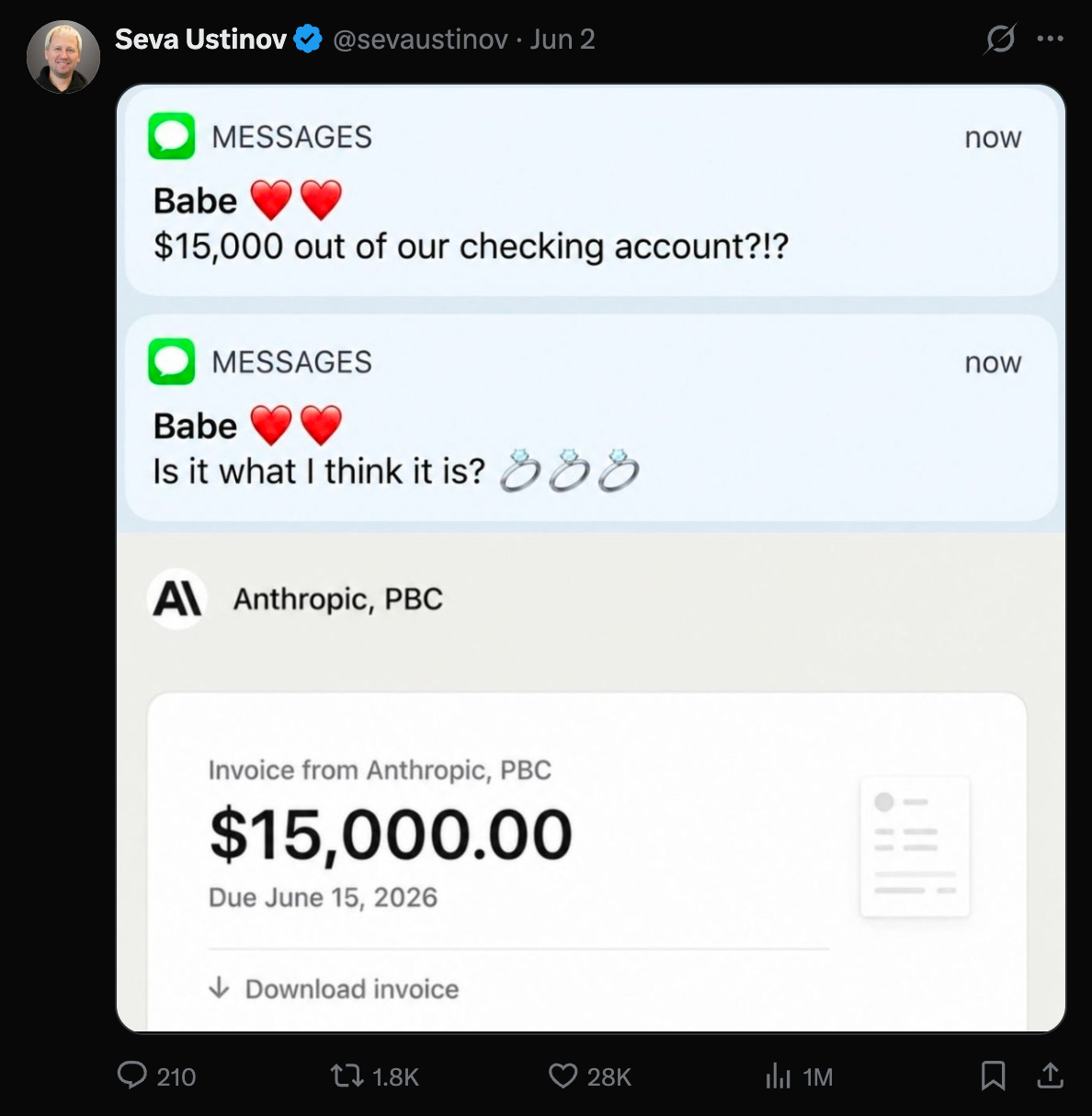
Credit: @sevaustinov
Connect with YAP Global: Website, X & LinkedIn
The usual disclaimer: This newsletter collates the main themes and headlines of the week in DeFi/crypto/metaverse/Web3/NFT land and tries to provide unbiased context. It’s aimed at anyone who wants to keep an eye on the space. It’s put together by a team at YAP and doesn’t contain any promotion of our clients (if one is mentioned, we’ll flag that).
The team: Founder Samantha Yap, Samvidha Sharma, Sofia Anderson, Meghna Dembla, William Knight, Shajar Qureshi, and TJ Thomas. Your feedback is, as always, welcome. Ping us at thecontext@yapglobal.com. Old newsletters can be found here.
This newsletter is prepared by YAP Global, a financial and technology PR consultancy that advises companies in the digital assets, fintech, stablecoins, AI, and agentic finance sectors. Find out more about us here.